








Exercises and yoga poses during pregnancy

Expert advice on pregnancy exercises and yoga poses - Motherhood Hospital India

Always start with a breathing exercise. Close your eyes and breath in through nose and breath out through mouth continue for 3-5 mins

Diaphragmatic breathing

  1. Sit comfortably, with your knees bent and your shoulders, head and neck relaxed.
  2. Place one hand on your upper chest and the other just below your rib cage. This will allow you to feel your diaphragm move as you breathe.
  3. As you breathe in and out feel your hand over the diaphragm move out and in.

Diaphragmatic breathing
Cat and camel

  • Begin on your hands and knees, knees under hips, hands under shoulders
  • Round your back up toward the ceiling, drop your head slightly, tuck in your buttocks
  • Come back to a neutral position
  • Let your belly lower toward the floor creating an arch in your back
  • Keep your head up slightly, with your eyes looking straight ahead
  • Alternate between poses.

Make it easier: For painful knees, fold a towel or blanket under the knees. For painful wrists, place fists instead of palms on the floor.
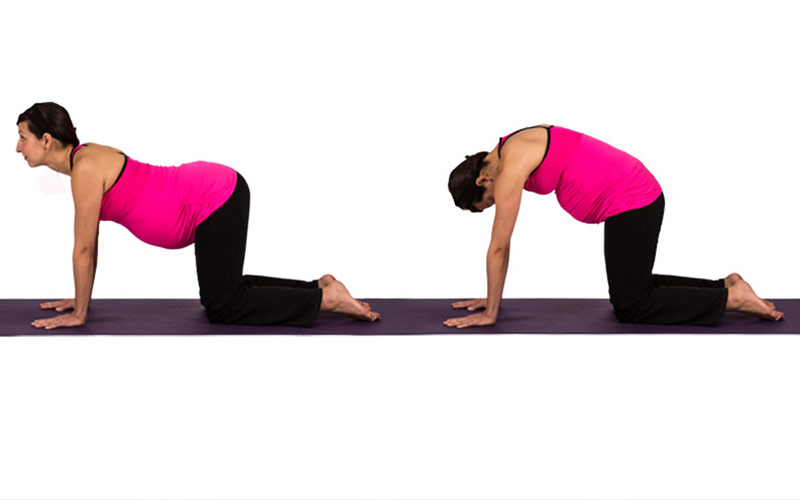
cat and camel


Butterfly pose

butterfly pose

  • Keep the spinal cord and neck straight
  • Breathe natural and easy
  • Bend both the knees
  • Bring the soles of the feet together and place them up to the crotch area
  • Grasp firmly both the paws with your hands
  • Do not allow the heel to be raised
  • Keep the torso above waist including the neck straight
  • Place the elbows on the thighs
  • Inhale deep and press both the thighs downward with the elbows effortlessly
  • Remove your hands from thighs and try to raise the knees without any support; exhale Breath

Kegel’s Exercises

It is done to tone up pelvic floor muscle. It can be done in any position sitting, standing, and lying whichever position you are comfortable. Contract your pelvic floor muscles as you would to stop urine flow for 5 seconds and then relax the muscles for 3 seconds. This muscle fatigues quickly so only do five to ten repetitions at a time. Do not hold breath anytime, breathe normally while doing this. Repeat the set of 10 at least twice a day.

Goddess pose

godess pose

  • Start in Mountain Pose at the front of your mat. Step your right foot a stride length towards the back of your mat. Turn your toes out and your heels in, so your feet land on a 45 degree angle
  • Bend your knees deeply out the sides and sink your hips down to the height of your knees
  • Bring your arms out at shoulder height and bend your elbows so that your fingertips point skyward. Spread your fingertips wide apart from one another and activate the muscles across your back to hold your arms here
  • Engage your core muscles and draw your tailbone in the direction of the floor. Do not hunch forward with your shoulders; keep your spine long and your muscles engaged
  • Stay here for 30 seconds to one minute, then step forward to Mountain Pose
Warrior Pose
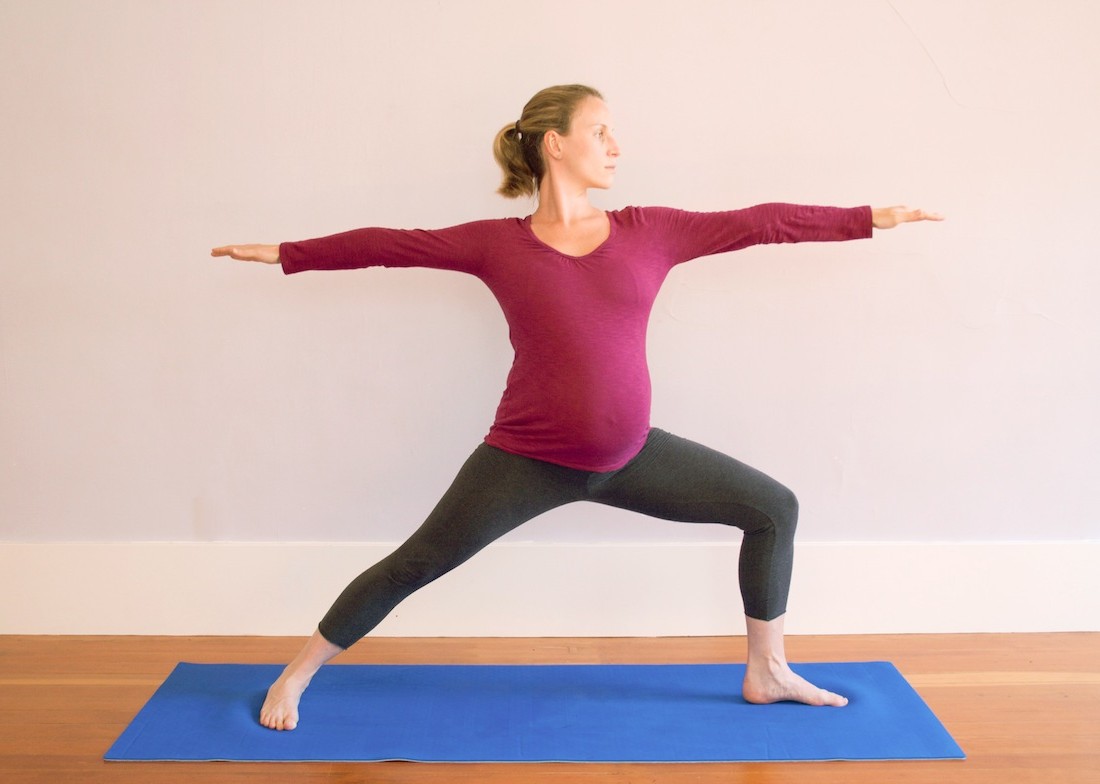
warrior pose

Stand with your feet about three feet apart your right foot in front of the left. Hold your arms out to the side with your palms down and arms extended and straight. Turn your right foot out to the side and your left foot in. Lunge forward gently, bending your right knee as you keep your left leg straight. Hold the pose as your legs stretch. Return to the original position then switch legs.

Side stretch

  • Sit on the floor with one leg bend and other stretched.
  • One of the arm extend over the head stretching the side
  • Come back to original position and repeat other side .

Walking

Walking is a great pregnancy workout. It is low impact so it doesn’t jar your knees or ankles. It is a moderate intensity exercise and will help keep your blood sugar stable. It is also probably the easiest exercise to do because it requires no equipment besides some good tennis shoes and you can do it anywhere, you can walk for 30-45minutes per day, but remember only walking is not sufficient.


Everything you need to know about PCOS

What is PCOS or PCOD?

Polycystic ovary syndrome (sometimes sadly referred to as disease) is a problem in which a woman’s hormones are out of balance. It can cause problems with one’s periods and make it difficult to get pregnant. PCOS also may cause unwanted changes in the way you look. If it isn’t treated, over time it can lead to serious health problems, such as diabetes, heart disease and even cancers!

Most women with PCOS grow many small cysts on their ovaries. That is why it is called polycystic ovary syndrome. The cysts themselves are not harmful, but lead to hormone imbalances.

Did you know that symptoms of PCOS persist even when both the ovaries are removed?
The root cause of the problem is the brain, the hormone regulation centre at hypothalamus, with involvement of multiple organs (Multi-system disease).

Some of the symptoms
  • Acne.
  • Weight gain and trouble losing weight.
  • Extra hair on the face and body. Often women get thicker and darker facial hair and more hair on the chest, belly, and back.
  • Thinning hair on the scalp.
  • Irregular periods. Often women with PCOS have fewer than nine periods a year. Some women have no periods. Others have very heavy bleeding.
  • Fertility problems. Many women who have PCOS have trouble getting pregnant (infertility).
  • Depression.

As if it was not bad enough, it increases your chances of developing a big disease later on in life, like full-blown diabetes, autoimmune thyroid disease and even cancers. Today I want to spread the awareness about Bio-cycle study. You can read the whole study in the oxford journal but the conclusion is here: If you have a hormonal imbalance in your 20s or 30s,( like pcos, irregular painful periods, or even something as small as PMS, it significantly increases your chances of developing a big disease of inflammation in the later life(40,s and 50,s) like diabetes, autoimmune thyroid disease and some form of cancers!

The BioCycle Study – Influence of Endogenous Reproductive Hormones on F2-Isoprostane Levels in Premenopausal Women.

The Treatment

The western medicine today, deals with identifying and treating the symptoms around PCOS. But these spot treatment are at best described as bind-aid solutions to a much deeper problem that gets worse not only due to the ignorance of the root cause but also as side-effects of these symptomatic treatments over long periods of time.

If you have been diagnosed with PCOS, chances are you have been prescribed to Birth Control Pills or OC’s (oral contraceptives) for regularising hormone cycles and hence periods and metformin for elevated blood sugars or pre/diabetic conditions. All in an attempt to masking the symptoms BUT they come back in a worse form once synthetic hormones are stopped.

Lets have a look at these two so that you can get to the root of the problem and avoid potential side effects of these.

Birth Control Pill

What it does:

The synthetic hormones in the birth control mask your natural hormonal patterns to prevent ovulation from happening, and therefore prevent pregnancy. The menstrual period you experience on the pill is not an acutal period, but rather a break-through bleed that occurs from the drop in estrogen. So even though it might be regulating your cycle, once you get off the pill chances are your period will return to the same state is was before and mostly it gets even worse.

Side effects:

Off the several side-effects, one side effect most relevant to PCOS is that it increases testosterone uptake, which can make your androgenic symptoms worse. This means if you re experiencing hirsutism (hair growth in unwanted places), head-hair loss, or acne, it could potentially get worse with the pill.

Alternative solutions:

Re-establish your monthly ovulation and menstruation through restoring key micronutrients and helping your body to eliminate excess estrogen or other hormones that could be impeding your natural flow. Addressing adrenal fatigue and thyroid issues is also key here. And the great news is – all of these can be achieved via our program.

Metformin (Glucophage)

What it does:

Metformin helps with blood sugar and insulin management by suppressing glucose production by the liver. It’s commonly used for diabetes and PCOS with insulin resistance.

Side effects:

In a recent study, metformin was found to cause an impairment mental cognition. It’s more commonly known to cause serious digestive issues like gas, bloating, diarrhea, constipation, and more uncomfortable symptoms.

Alternative solutions:

Address your blood sugar balance through your diet and key supplements as I teach you in the program.

Not only they do not help, they damage your body in the long run!

If you are diagnosed with PCOS and you have been offered a prescription of birth control pills & synthetic hormones, PLEASE STOP!

The advice to lose weight & exercise more does not completely work either. They say that you should lose weight to be healthy but I say that you should be healthy to lose weight. I am sure you can relate to that. I am not here to criticize any system, and each kind of treatment has its own role.

Conclusion

Very often you ll be told that the only thing you can do is take a pill, but I hope this article has opened your eyes to other possibilities and helped give you your power back when it comes to making informed decisions about treating your PCOS symptoms.

There is no quick fix to treating PCOS. It is a systemic issues that needs to be managed through diet and lifestyle and holistic approach

If you re ready to get to the bottom of your hormonal imbalances once and for all, let me help you. Your body CAN work for you .Stop suffering. Start feeling good all month long.

My thoughts

I believe it is my responsibility to share what I ve learnt so that you and many others are not held back by PCOS & hormone imbalances, but rather use it as a way to improve your lives. I want to empower you.
I want you to be the captain of your own ship because I know that if we take the necessary steps, we can improve not only our own lives, but those of our family, community & the world at large.

The journey of a thousand miles begins with a single step
I will be glad if you choose to take that first step with me.

Wishing you health & happiness!

Content Credits Dr. Disha Sridhar

Are you a working Mom?

If you are a working woman and you happen to be expecting, it is important for you to apply for your maternity leave. The Maternity Act of 1961 under the Indian Constitution lays down the maternity rights for women across all the industries ranging from industrial to agricultural. Any woman who is entitled to a salary from her employer is entitled to this maternity leave under this act.

Maternity leave is important for every expecting mother. However, in many cases there are demanding situations which require her to work in order for her to pay her bills and take care of her household. For instance, women who work as nurses, waitresses or teachers do not get the liberty to work from home because such is the nature of their jobs. They do not have the option of working through e-mails also. Thus, they end up returning back to their jobs as quickly as possible because they have bills to take care of and cannot afford to lose their jobs.

Research claims that it is extremely of high importance that a woman, while she is pregnant must take enough maternity leave to ensure good health for her baby and herself. During pregnancy, it is important for her to take adequate rest, eat healthy and remain stress free. And when women work during pregnancy, they are naturally inviting work stress and an imbalance in their work-life. Maintaining a work-life balance is of utmost importance in a working woman’s life. This escalates to a higher importance during pregnancy. Few women give more importance to their work and tend to ignore matters related to their health.

Once you become a mother, your responsibilities are doubled and you need to make greater efforts to maintain a healthy work-life balance. It has been observed that women with short maternity leave tend to fall prey to negative outcomes in terms of health, stress and the baby’s health. And it has been observed that women with two or three month old infants, working full-time reported higher levels of stress, depression and poor health conditions when compared to women who stay at home during their pregnancy, and for a while post-pregnancy. Not only does it affect the mothers, it has an adverse effect on the children also. Conditions like clinical depression, anxiety and psychological distress might sustain in your child’s life.

In many cases, the issue is not about the expecting mother taking maternity leave, it is about the employers who are whiny about giving adequate maternity leave. Hence, the real problem comes down to how many days you can take off under maternity leave. It is all about the time you devote towards your motherhood and towards your baby once you deliver. Being a mom is not easy, especially a working mom. It has its own set of challenges to overcome. The key to this challenge lies in smart maintenance of work-life balance.


A Brand New Wardrobe for the Mommies-to-be!

It’s that time in your life where you stare at your wardrobe and tell yourself that you have nothing to wear. Certain things have to be kept in mind when you join the league of the mommies-to-be. Everything takes an extra effort, your diet, your daily regime and even your wardrobe. You must be elated about having a baby but at the same time the prospect of giving up all your lovely outfits and accepting yourself in extra-large dresses must be eating you up. This is a common notion around.

Accessorizing an existing wardrobe is completely different from creating a whole new one, especially if you are an expecting mother. Wardrobe tweaking can be delightful if done with the right mindset and knowledge.

Comfort is of utmost importance while picking clothes for your new wardrobe. If it is a single pregnancy, chances of showing are lesser till the second trimester. You might still be able to fit into your loose clothes till then. But it is always better to have some clothes ready, just in case you start showing earlier during the single pregnancy cases. Having a practical collection in hand is always convenient.

Dressing smart is as important as dressing comfortable. Switch to trousers from Jeans and team them up with a smart top. A pair of jeans or trousers that are low-cut and adaptable to your widening waistline is a smart choice. Your maternity wardrobe must include tops that are loose and comfortable. Wrap-around tops are comparatively better because they fit you according to your body shape and size. Similar to wrap-around tops are wrap-around skirts which make a lovely combination with the tops.

Shopping smart is the key to a practical maternity wardrobe. Clothes made out of lycra or cotton jersey tend to be stretchable and can prove to be useful during the pregnancy term. An important detail which most women are likely to forget is that the body temperature keeps fluctuating often during pregnancy. Wearing layers is probably the best bet during this phase because you can either put on or take off the layers according to the temperature.

It is not necessary for you to hide in extra-large tent like dresses if you are pregnant. You are at liberty to show off your best features and dress confidently. Wear a short skirt and show off your slim legs, or wear a sleeveless/cap-sleeve top to highlight your toned arms. Choose outfits which help you blend comfort with style. Match your outfits with accessories or scarves and deck up your maternity look.

Motherhood Wins Prestigious Healthcare Excellence Award

Bengaluru, Sunday, June 22, 2014: Motherhood, the premium birthing boutique and woman & child healthcare provider, received a pivotal boost when it was awarded with Healthcare Excellence Award, as the best single specialty hospital in Obstetrics & Gynaecology, at the Indo-Global Healthcare Summit & Expo 2014 in Hyderabad on 22 June 2014.

As a single specialty birthing boutique, we strive to provide family-centered care to woman and newborn, says Motherhood chairman Dr. Mohammed Rehan Sayeed. This award recognizes our ongoing efforts to be the best birthing boutique and providing exemplary care to woman through their pregnancy and beyond. I congratulate the entire Motherhood team for their contribution in winning this award, he further added.

Telangana deputy chief minister and health minister Rajaiah was the chief guest at the Indo-Global Healthcare Summit & Expo on innovations and advances, which was held at Taj Krishna and Taj Deccan, Hyderabad, India. The summit is meant to provide a platform for identifying and sharing successful innovative models of healthcare delivery from around the world which will help professionals, entrepreneurs, industry players, global institutions to collaborate for taking advantage of the latest innovations and advances, Indus Foundation (New Jersey) president S A Anumolu told reporters. The event was jointly organised by Indian Medical Association, Andhra
Pradesh government, Federation of AP Chambers of Commerce and Industry and the Indus Foundation.

Motherhood was selected out of a distinguished group of finalists. Around 4,000 Indian and foreign healthcare professionals participated in the event. Mr. Mehdi Kalim, General Manager – Business Development, received the award for Motherhood. The award highlights Motherhood’s commitment and dedication to providing commendable birthing, gynaecological and paediatric services.

Motherhood is a chain of single specialty premium birthing boutique. With centres in Bangalore, Chennai and Hyderabad, Motherhood has to its achievement over 1000 gynaec procedures, 3,500 deliveries and more than 60,000 consultancies in a span of 36 months. Being a premium boutique birthing center, standing for exclusivity and personalized care, Motherhood provides the state of the art infrastructure, expert services leading to a carefree pregnancy.

About Motherhood Hospital
Motherhood is a premium specialty birthing boutique with state-of-the-art facility and gynaecology, obstetrics and paediatric services. A chain of Bangalore-based Rhea Healthcare, Motherhood was first set up in Bangalore in the year 2011. In a span of 36 months, Motherhood has branches in Chennai, Hyderabad and two units in Bangalore, with a third unit scheduled to be launched shortly in Hebbal (Bangalore).

At Motherhood, the facilities include LDR (Labour, Delivery, Recovery) Rooms that converts ones homely rooms into a fully functional medical setup within minutes without the need to move, an impressive nurse to patient ratio leading to a higher responsiveness level for any kind of doubts, 2 well-equipped Operation Theatres, a level 3 Neonatal Intensive Care Unit catered to by a team of dedicated neonatologists from the best centers in the world and a Maternal Intensive Care Unit to ensure the highest standards of safety for the new born and the mother.

With a 24/7 coverage with qualified specialists, Motherhood is all about setting standards in healthcare delivery. Motherhood was also the first center to emphasize the importance of fetal medicine and Anomaly Scans.

Why do you need a Midwife?

If you are mother-to-be, you start preparing yourself for a number of things which you wouldn’t follow much if you weren’t expecting. You start following a proper schedule which lays down your activities for the day like how much time to spend on exercising, or at what intervals to eat etc. Taking you through this pregnancy is the job of a midwife or a healthcare provider who is in charge of prenatal care, the delivery, postpartum services.

Women usually see an OB-GYN during their pregnancy. But there are a lot of women in India who choose to have the guidance of both OB-GYNs and Midwives. Sometimes, they also opt for their family physician. But in most of the cases, the family physicians would have discontinued obstetrics training as it does fall under the purview of their predominant services. The whole idea behind appointing a midwife is for the mother to be comfortable as they do not share the same level of comfort with their doctors.

Your healthcare provider can be your OB-GYN, your midwife, your family physician, nurse practitioners, or perinatologists (doctors specializing in high-risk pregnancy). Usually, midwives are qualified enough when it comes to providing you with a quality pregnancy i.e. giving you a good pre-natal care and help you if you have a normal pregnancy. They help you experience the childbirth you want to experience. Midwives are exceptionally good at providing care and attention during term pregnancy and are easy to connect with. More than the physical care, they are also good at providing mental support and care to the pregnant woman and her family. They respect your wishes and practice what is in the right setting for you.

However, in cases of high-risk pregnancy or pregnancy which involves complications it is always better to consult a specialist. There are a lot of nurse practitioners who ace at dealing with complications during pregnancy but it is any day recommended that you see a specialist as a safe measure. Pregnant women must avoid in all circumstances, the intake of medications unless suggested by the healthcare provider. These medications must be discussed with the midwife before consumption. Not just the medications, every issue that arises during pregnancy like morning sickness, diet plans, exercise routines etc. should be discussed with the midwife.

Midwives usually have the knack of being able to help you deal with crisis during pregnancy like fever, vaginal bleeding, belly pain, irregular movements of the baby etc or any sort of emotional disturbance, mental trauma etc. These circumstances are difficult to deal with, and your midwife helps you get through such situations. Also they help you get through delivery with much more ease as compared to the doctor.

Quality Of Pregnancy

" Essential Pre-natal Services & Nutrition for Healthy Pregnancy - Motherhood Hospital India"

Before the advent of modern age medicine, not a lot of mothers and their babies would survive pregnancy and childbirth. Pregnancy and fetal development takes a toll on both the mother and the baby and thus requires a lot of efforts from the side of the mother. Being a mother instills a lot of strength and patience in a woman.
In cases where the mother or the baby or both do not survive the pregnancy and the childbirth process, the quality of pregnancy is blamed most of the times. The quality of pregnancy depends upon a lot of things but most importantly it depends on good pre-natal care. It can significantly improve the quality of pregnancy and ensure that the upshot for the mother and the baby is good.

To begin with quality pre-natal care involves a lot of things like nutrition, routine ultrasounds, frequent examinations of the mother and the baby for any sort of diseases or infections etc. and if found any, then treatment for those diseases. Good health habits are instrumental in ensuring that the quality of pregnancy remains good. Ultrasounds are highly essential in order to monitor the baby and to detect any problems with the baby, if any. Regular pre-natal examinations include routine screening for problems/diseases/infections in the mother’s body to check for Blood pressure issues, Diabetes, any kind of genetic disorders, blood type issues like ABO and Rh, STDs, protein in the urine etc.

The quality of pregnancy diminishes due to either lack of resources to keep the mother healthy or due to carelessness. Miscarriages that happen because of a poor pre-natal attention can easily be avoided by ensuring that the expecting mother is given enough attention and care for to keep her and her child healthy. Pre-natal care also helps in analyzing cases of high-risk pregnancy and monitoring the baby and the mother throughout the pregnancy.

The diet of the mother is of utmost importance during and after the pregnancy. The expecting mothers must follow a balanced diet, keeping in mind the weight management requirements. Folic acid should be a part of the motherŸ??s well-balanced diet without fail. A minimum of 0.4 milligrams of folic acid is necessary in the diet. Folic acid is essential because it helps in decreasing the risk of certain defects in birth.

In addition to the above mentioned points, pregnant women must also avoid all types of strong medication during pregnancy as they might hinder the process of fetal development by creating certain complications. Alcohol and tobacco must be strictly avoided during pregnancy and caffeine intake must be limited. Follow these steps and you can be assured of a good quality pregnancy.

Harmful Effects Of Oral Contraceptive Pills

Oral contraceptives are birth control pills, which as the name suggests are taken orally, to avoid pregnancy. While they are easier for birth control, having known the harmful side effects, one may find it difficult to swallow one. Healthy women have meager chance of having severe side effects. For women who smoke the effects are far worse. Smoking cigarettes increases your chance of having heart problems; which increases with age (especially in women greater than 35 years of age). The pill contains synthetic forms of estrogen and progestin hormones.

SIDE EFFECTS: If you undertake these pills you should undergo a complete physical examination that includes blood pressure measurements and breast/pelvic examinations at regular intervals. Taking birth control pills may cause the following harmful effects.

Common Side Effects

  1. Nausea and dizziness
  2. Frequent tiredness or weakness
  3. Vomiting
  4. Mood swings
  5. Weight gain or loss
  6. Changes in pattern of menstrual cycle and bleeding.
  7. Abdominal cramping, bloating or stomach upset causing discomfort
  8. Acne problem due to hormonal imbalance
  9. Breast pain, tenderness, or swelling.
  10. Swelling of ankles and feet
  11. Gain or loss of body or facial hair
  12. High blood pressure

Less Common Side Effects

  1. Headaches or migraines and loss of co-ordination
  2. Severe depression and weakness
  3. Gum inflammation
  4. Urinary tract or vaginal infection, itching or irritation
  5. Sensitive skin causing brownish, blotchy spots on skin exposed to sunlight
  6. Aggravation of asthma
  7. Groin, chest or calf pain
  8. Changes or lumps formed in the breast
  9. Increased or diminished interest in sexual intercourse and responsiveness
  10. Coughing up of blood
  11. Loss or change in vision
  12. Change in speech pattern
  13. Increased risk of gallbladder disease
  14. Blood clots or stroke
  15. Benign liver tumors or liver cancer

Beneficial Uses:

While there may be many adverse effects of taking oral contraceptives, there are some positive beneficial uses that accompany the use of the pill.

1)It is used to regulate your menstrual cycle & predictable periods

2)Reduces acne problem

3)Diminished risk of ovarian cancer & benign breast disease

4)Reduced risk of iron deficiency anemia.

Prolonged use of contraceptives (beyond 4-6 months) should be taken under the guidance of doctor. It is also important to discuss with him any serious health problems that you may be facing.

Note Do not smoke while taking these pills. Risk of these harmful adverse effect increases three fold.

How Do Vaccinations Work

Protective benefits of vaccination: Essential components of immunization - Motherhood Hospital India

A newborn is immune to some infections because it receives antibodies from its mother; this is called “passive immunity“. Passive immunity lasts for a few weeks or months. Ironically, that immunity begins to fade away in the first few months of life. So, it’s very important to follow an immunization schedule.

What is vaccination?

Vaccination protects you from specific diseases that can make you very sick, disable or even kill you. Vaccines help develop immunity by imitating an infection as it would react when it recognizes and fights the real infection. They trick the body into thinking it is under assault & trigger the immune system to produce its own antibodies (substances produced by the body to fight disease), as though the body has been infected with a disease without actually infecting us and harming us with the disease. This is called “active immunity“.

Thus, vaccination is like a dress rehearsal for your immune system so it is prepared for the real show .

How does it work?

When germs, such as bacteria or viruses, invade the body, they attack and multiply quickly. This invasion is called an infection , which causes the illness.

  • The vaccine contains antigens: harmless substances (such as dead bacteria or molecules) associated with the disease.
  • The body assumes the antigens are the actual disease, and its immune system stimulates white blood cells to activate and create antibodies – proteins that can fight the disease’s bacteria or viruses – the invading organism.

How are vaccines created?

Viruses and bacteria can be produced in the laboratory by infecting cells grown in tissue culture; thereby weakening or attenuating it by growing it repeatedly to carefully select a strain that’s less dangerous.The treated pathogen is then combined with stabilizers and preservatives, to produce a vaccine dose.

Does it have any harmful side-effects?

Seldom, vaccination can cause minor symptoms, such as fever. They are normal and can be expected as the body builds immunity. If a child was given 11 vaccines all at the same time, it would only use a thousandth of its immune system, so it does not harm the baby!

How long is the vaccine effective?

Generally vaccinations provide lifelong protection against a disease, but others need boosting. The duration depends on the disease that is being protected against, the vaccine and the person’s inbuilt immunity.

Some vaccines provide high levels of protection like MMR provides 90% protection against measles and rubella after single dose. Others are not as effective typhoid vaccine provides around 70% protection over three years; Tetanus may need boosters.

The antibodies don’t disappear even after their work is done. If these germs reappear, whether it’s a few weeks or many years later, the antibodies are ready to protect & prevent the infection.

Is one vaccination enough to give my child immunity?

The antibodies are very specific. They have been created to combat to a specific disease. The mumps virus, cannot to work against rubella. Thus, one should follow the immunization schedule. Young children are vulnerable to many potentially dangerous infections.

Can vaccination eliminate diseases?

The disease can be eradicated completely if the vaccination is given to most people, as has happened with smallpox and polio. If enough people in a community are vaccinated, it’s harder for a disease to infect even those people who have not been vaccinated. This is called “herd immunity“.

Preparing for Motherhood

Pregnancy comes as a surprise to some women. For others, it is a result of much planning and waiting. If you and your spouse are ready for the pattering of little feet around your house, here’s what you should know before trying to conceive.

Stop the pill

If you have been using contraceptives in the form of injections or pills, now is the time to stop using them. Let your periods regularize so you can keep track of your cycles.Research also suggests that use of lubricants act as barriers to sperms and so, use of lubricants should be avoided.

Know your body

It helps to know what happens during conception and how a pregnancy advances. Prior to that, observe and time your menstrual cycles and figure out when you ovulate. This is very essential as you stand a chance of conceiving only when the egg is still in your reproductive system. You will find several online tools to help you calculate your ovulation period or your most fertile period.

Also remember that you have just a 20 percent chance of getting pregnant each month. So don’t be alarmed if you did not get pregnant in your first attempt. Regular sexual intercourse specifically during the fertile period is important. However, if you have been trying for more than a year (or 6 months for women over 35 year), it might be time you met a fertility specialist.

Visit a gynaecologist

You don’t necessarily need to wait to get pregnant, in order to meet a gynaecologist. It is recommended that you schedule your first appointment as soon as you decide you want to have a baby. You can discuss your fears, apprehensions, medical history, and nutritional habits with your doctor. A gynaecologist might put you on multivitamins and folic acid supplements couple of months in advance.

It is also advisable to get a dental check-up done before you get pregnant.Some dental complications cannot be treated effectively during pregnancy and are linked to pre-term birth and underweight babies.

Eat healthy and exercise

You could also book an appointment with a nutritionist who can inform you the recommended daily nutrition needs based on your lifestyle and diet preferences. If you are underweight or overweight, it is advisable to get to a healthy weight before pregnancy. Also note that underweight/overweight women can have irregular ovulation, which can delay pregnancy.

Quit smoking and drinking

If you are a heavy drinker and smoker, you will have to cut down on it and eventually, stop completely. These habits have a very negative impact on reproductive health including ovulation and pregnancy. Talk to your physician about how you can quit smoking and drinking.

Most women get pregnant without much problem but if you follow the above tips, you can be assured that you are on the right track. We hope you found this information useful. Please feel free to share your thoughts on this topic in the comments section below.